During the 1950’s William Ringle Jr., reporter for Gannett, would write a column for the Rochester Times-Union which presented brief histories of street names around Rochester, NY. As his fellow avid toponymist, I have collected these articles whereever I have found them–and was most enthused when I came across a full scrapbook containing the cut-and-pasted articles in question.
I was excited to discover this particular one: plain old unassuming Churchlea Place–a one-way street with very few houses between Clifton Street and West Main Street, bordering a nigh-abandoned plaza–was once the site of a unique and important industry in early Rochester history. It was a rope-walk, a long narrow path adapted for the braiding of hempen rope and cordage.

Intriguing, as one so rarely considers the practical matters behind that product which literally tied together the world of trade. No rigged Lake Ontario schooners could stay their sails without it. No mule could drag its burdensome packet boat along the canal without it. No flag could be flown, no tent erected, no barns raised, no bell could be rung–and no man could be hanged. All for want of this simple staple, produced in quantity by Sidney Church along this single narrow dusty path.

https://www.newspapers.com/article/democrat-and-chronicle-rope-walks/121884819/
First Location
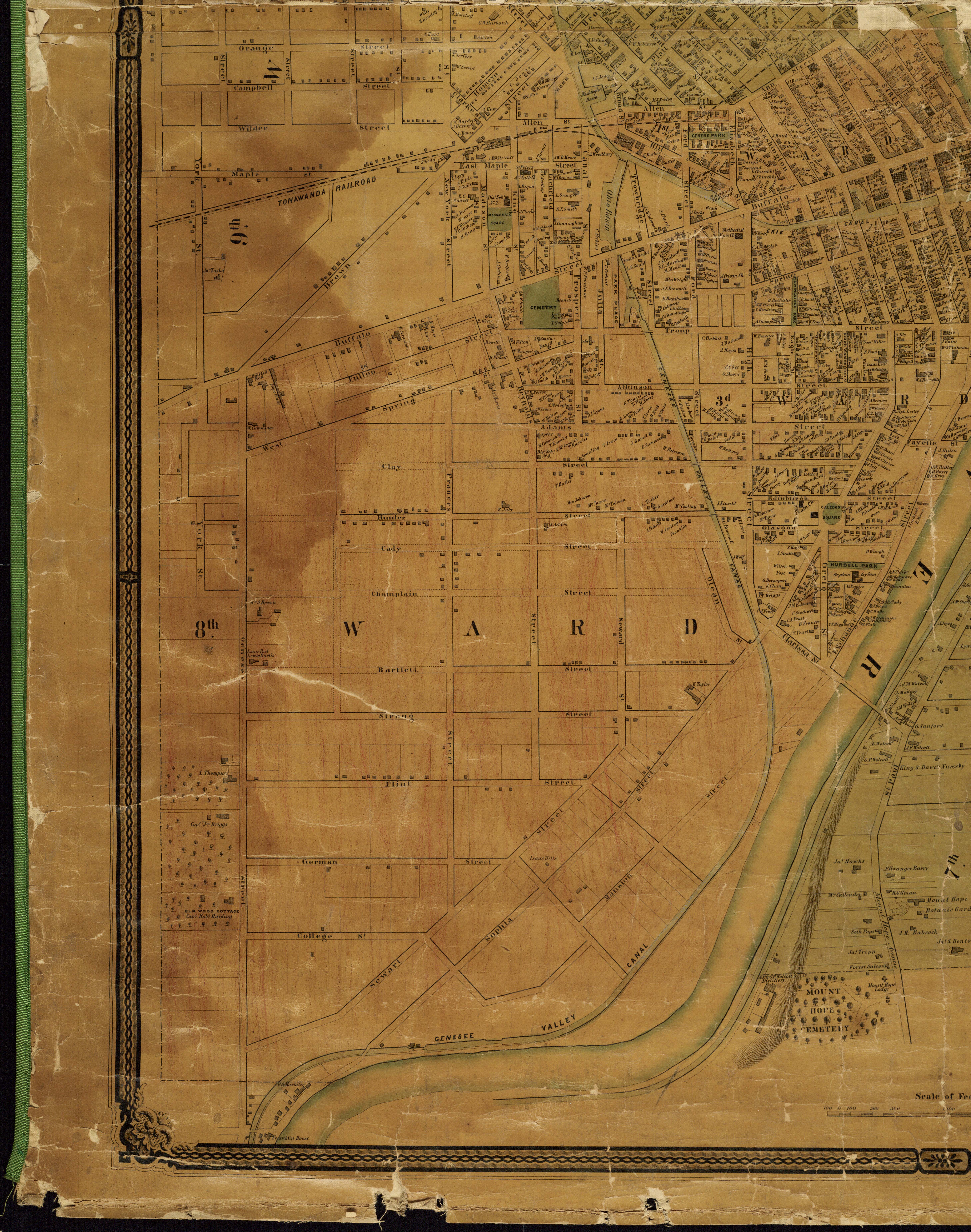
In 1830, when Sidney Church first began rope manufacturing in the city, his rope-walk was located between Trowbridge Street to the west and South Ford Street to the east.

Church’s first rope walk location, south side of Buffalo Street between Ford Street and Trowbridge Street.
https://www.loc.gov/resource/g3804r.ct005821/?r=0.16,0.464,0.251,0.153,0


https://www.google.com/books/edition/Publication_Fund_Series/16QFAAAAMAAJ?hl=en&gbpv=0 (pp.351-352)
The above [loosely] quotes from Henry Wadsworth Longfellow’s “The Ropewalk”. Interestingly, Sidney Church’s mother was a Wadsworth, a daughter of 1st Lieutenant Roger Wadsworth who served for three years during the Revolutionary War. An intriguing coincidence–however they were not related [insofar as I could track down.]
In 1849 Sidney Church moved his ropewalk west along Buffalo Street, near the corner of Genesee Street. We’ll visit that location in the next section; for now, we’ll fast forward through time and see what became of Church’s first location in its future.

Location of Sidney Church’s house in 1851.
https://photo.libraryweb.org/rochimag/rpm/rpm00/rpm00446.jpg
Though Sidney Church had moved his rope walk westward, a property of his still stood across the street from the ropewalk’s original location, between Ford and Trowbridge. By 1875, Church has vacated the property. The stone yard and stone-cutting shop of well-regarded sculptor, Peter Pitkin, began to overtake the area. Pitkin is credited with the carving of many of Mt. Hope’s finest markers, such as the Potter monument below:


https://www.google.com/books/edition/The_Rochester_Directory/zF8DAAAAYAAJ?hl=en&gbpv=1

The stone cutting shop and stoneyard of Peter Pitkin.
https://catalogplus.libraryweb.org/?section=resource&resourceid=1116158794

The house of Peter Pitkin.
https://photo.libraryweb.org/rochimag/rpm/rpm00/rpm00250.jpg
Eventually, by the 1888 plat map, Peter Pitkin would have a large brick house across from his stoneyard. in 1889, this house would be purchased and added onto to create the Western New York and Pennsylvania Railroad Station.

https://www.loc.gov/resource/g3804rm.g3804rm_g06217189202/?sp=3&r=0.029,0.286,0.66,1.081,90#

[https://photo.libraryweb.org/rochimag/rpm/rpm00/rpm00166.jpg]

https://catalogplus.libraryweb.org/?section=resource&resourceid=1115904207

Second Location

https://catalogplus.libraryweb.org/?section=resource&resourceid=1116704728
The Rope Walk can be seen here next to Halsted Hall, a “hydropathy and motorpathy” clinic run by Hatfield Halsted. Basically, water therapy and physical therapy, for a number of maladies–including masturbation, in case you were concerned you wouldn’t qualify.
After seeing some use as annex for wounded Civil War soldiers, Halsted Hall was remodeled and, in 1868, became St. Mary’s Boys’ Orphan Asylum.
[https://www.libraryweb.org/~rochhist/v32_1970/v32i4.pdf]
[https://rochistory.wordpress.com/2019/01/31/down-on-the-corner-taverns-and-transformations-in-the-bulls-head-neighborhood/]

https://libraryweb.org/~digitized/books/Roman_Catholic_institututions_of_the_city_of_Rochester.pdf


https://www.loc.gov/resource/g3803m.la000519/?r=0.799,0.337,0.064,0.039,0

https://www.loc.gov/resource/g3803m.la000519/?r=0.799,0.337,0.064,0.039,0
As noted in the 1858 map of Monroe County, Sidney Church dealt his wares at No. 12 Buffalo Street, at a “ship’s chandlery” shop.

https://www.libraryweb.org/rochcitydir/images/1859/1859a-c.pdf
Given the time frame, address, and type of product involved, it seems safe to suppose that Sidney Church worked alongside James Fields, whose famous James Field Company would last for four generations of James Fieldses. No. 12 Buffalo Street was its location until 1860, when it removed to Nos. 41-43 Exchange Street.

https://www.google.com/books/edition/Genesee_Farmer/zpE5AQAAMAAJ?hl=en&gbpv=0

https://www.google.com/books/edition/The_Rochester_Directory/zF8DAAAAYAAJ?hl=en&gbpv=0
By 1870, Sidney Church has a “sales depot” at No. 18 Exchange Street:

https://photo.libraryweb.org/rochimag/rpm/rpm00/rpm00126.jpg

Labelled as “Cordage Manf’y”
http://photo.libraryweb.org/rochimag/rpm/rpm00/rpm00140.jpg

Labelled as “Rope Walk”
http://photo.libraryweb.org/rochimag/rpm/rpm00/rpm00249.jpg

https://www.newspapers.com/clip/120987368/sidney-church-obituary/

https://www.findagrave.com/memorial/24952253/sidney-church
Church Walk
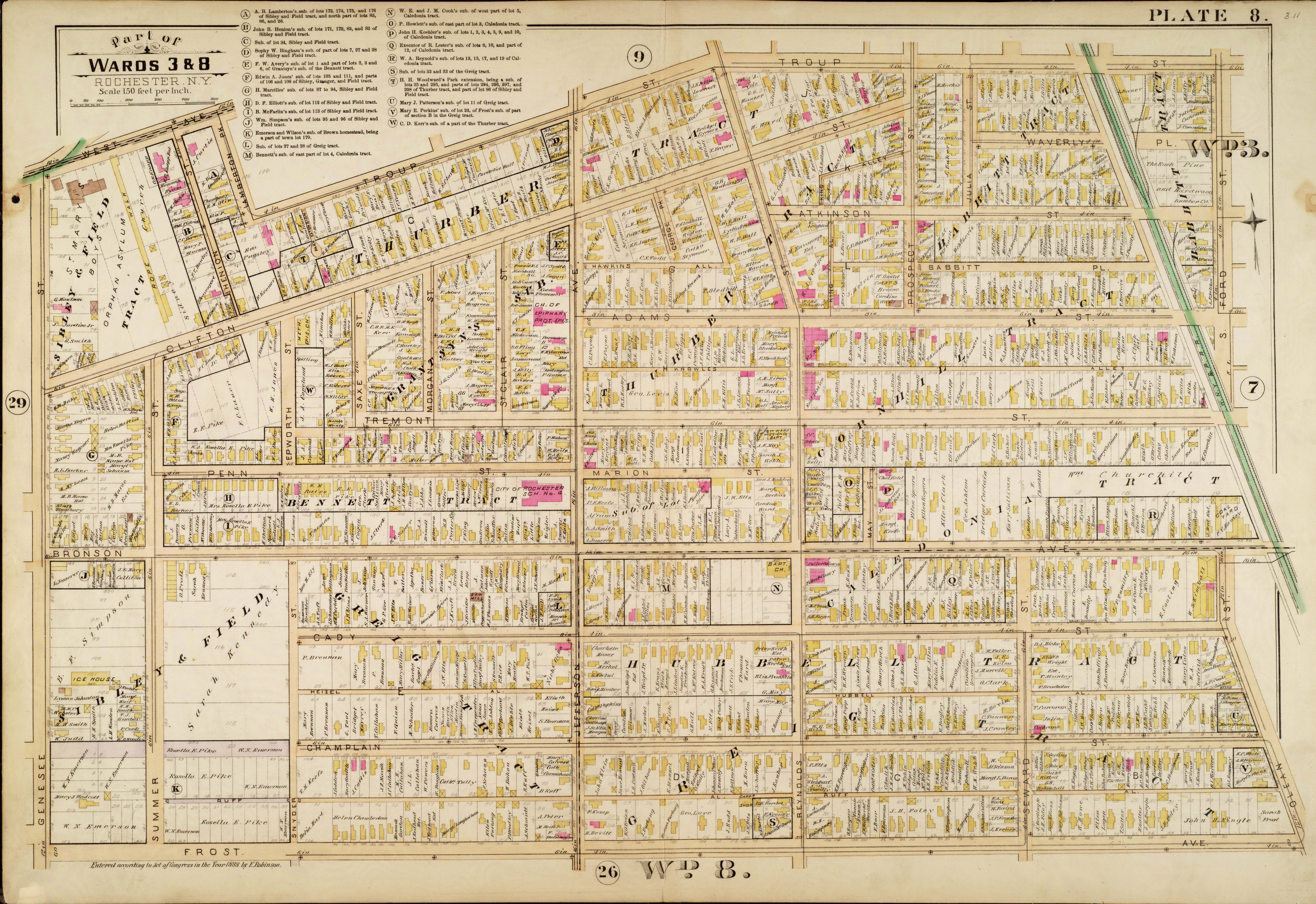
With Sidney Church’s death, the rope walk closed. The long path would become a street connecting West Avenue and Clifton Street, called “Church Walk”. Willed by Church to his daughter, Lily J. Church Arvine, the two acres along Church Walk were rapidly developed.

https://www.loc.gov/resource/g3804rm.g3804rm_g06217189203/?sp=50&r=0.035,0.375,0.947,0.532,0
As one can see, by 1892 the St. Patrick’s Female Orphan Asylum has joined the St. Mary’s Orphan Boys’ Asylum along Churchlea Place, facing Clifton Street:

https://libraryweb.org/~digitized/books/Roman_Catholic_institututions_of_the_city_of_Rochester.pdf

https://www.newspapers.com/article/democrat-and-chronicle-churchley-place/121026164/
For some reason, it was deemed necessary by Lily Church Arvine to alter the name “Church Walk” to “Churchley Place”. Since we know the street ended up as Churchlea Place, I assume the article misspelled the intended new name. Or else there was a very big screw-up in city hall, and it actually was meant to be “Churchley Place” after all.
Churchlea Place
“When Sidney Church died he left his youngest daughter two acres of land between West Avenue and Clifton Street. Starting around 1891, Arvine successfully developed it into Churchlea Place, a middle-class neighborhood that attracted staff of the nearby St. Mary’s Hospital and businessmen from Bull’s Head. She and her mother lived at No. 1. The street is now partially redeveloped as part of the hospital campus, but some of the original houses remain.”
[https://www.sally-parker.com/blog/lilys-legacy]

http://photo.libraryweb.org/rochimag/rpm/rpm00/rpm00174.jpg

https://www.newspapers.com/article/democrat-and-chronicle-lily-j-church-ex/129389248/

https://www.newspapers.com/article/democrat-and-chronicle-obituary-for-lily/133767922/

https://www.newspapers.com/article/democrat-and-chronicle-churchlea-one-way/121027934/
I just included this because I thought it was funny, and also because it provides a glimpse at No. 837 West Main Street, previously No. 399 West Avenue. The property was built sometime between 1892 and 1900, and for most of those years thereafter served as the home and office of dentist Fred J. Tarrant. The property is now a parking lot for the “Bull’s Head Shopping Plaza”, if one can properly still call it that.


https://www.loc.gov/resource/g3804rm.g3804rm_g06217195001S/?sp=39&r=0.135,0.241,0.544,0.968,90

https://www.newspapers.com/article/democrat-and-chronicle-ap-bulls-head-a/134111810/

https://www.newspapers.com/article/democrat-and-chronicle-15-17-churchlea/134115665/
A glimpse of two of the houses on the west side of Churchlea Place, Nos. 17 and 19, after a vicious fire. These houses, along with the others along the west side of Churchlea, would be torn down entirely for the 1982 renovation of the Bull’s Head Plaza.

Green: William G. Nichols home.
https://www.loc.gov/resource/g3804rm.g3804rm_g06217195001S/?sp=39&r=0.435,0.489,0.165,0.27,90

https://www.newspapers.com/article/democrat-and-chronicle-bulls-head-demol/134113938/
That brings us as close to today as I feel any need to get into. I tried mostly herein to account for the reasons Churchlea Place ended up how it did; why certain structures were razed, and why the ones there still remain. In many ways, it’s a scarred little street. It was raised with a certainty of purpose, then made to alter its goals in its middle age. After a mixed set of experiences–births, weddings, parties, yes, but also stabbings, shootings, purse-snatchings, assaults, deaths, fires–the benighted street was bereft half of its homes. Now it is a quiet shadow of its former self, tucked away in a quiet corner next to an empty plaza.
But it remembers when the boys walked up and down its length, twisting the fibers together on the wheel. It remembers its many decades as the beating heart of an industry. It’s memories like these that keep a street hanging on.
Supporting Gonechester
Did you enjoy what you read? Consider giving me a little tip at buymeacoffee.com/Gonechester, by way of saying “thanks!” It’s not necessary, but it certainly helps!





Leave a Reply