One artistic activity that enjoys perennial revivals in popularity is the painting of murals. Whenever a large enough expanse of wall grows a bit dull or neglected, there’s always an enterprising artist or two who come along to spruce it up with their particular aesthetic flair. More often than not, it’s framed as a revival in spirit, a way to bring a neighborhood together in the act of creative expression, and a visual cultural unifier reflecting the unique character of a neighborhood.
Whether or not these murals turn out any good is rather secondary to these intended purposes; some of the charm can come from the folk quality of a local schoolteacher or a handful of highschoolers painting on the cinder block canvas. Other efforts, such as Wall/Therapy, have engaged more professional-grade artists to paint murals on select buildings, with some very lovely examples as a result.
One of the inescapable realities of the mural as an art form is its ephemerality. Rarely do they last more than a decade or two. Interior or exterior, murals experience many avenues of destruction: a business changing hands can delete even the finest mural if it does not fit the current business’ aesthetic. Exterior murals are subject to the rigors of Rochesterian winters and the paint-destroying qualities of ultraviolet radiation from the sunlight.
In this group of posts, I will be selecting some murals–some of note and some unknown–which graced Rochester, NY walls but are now only a memory. Ephemeral murals.
Ephemurals.
Ephemural #1: The H. L. Green Co. Harriton
Many murals began as the project of a private business, to set their store apart or to draw attention to their wares. You may be familiar with the hundreds of thousands of painted signs and advertisements which used to bedeck building walls in the 19th and 20th centuries, some of which are still extant as faded remnants. Even discounting advertisements, many businesses spent their capital to create mural-scale artworks for their shops or lobbies.
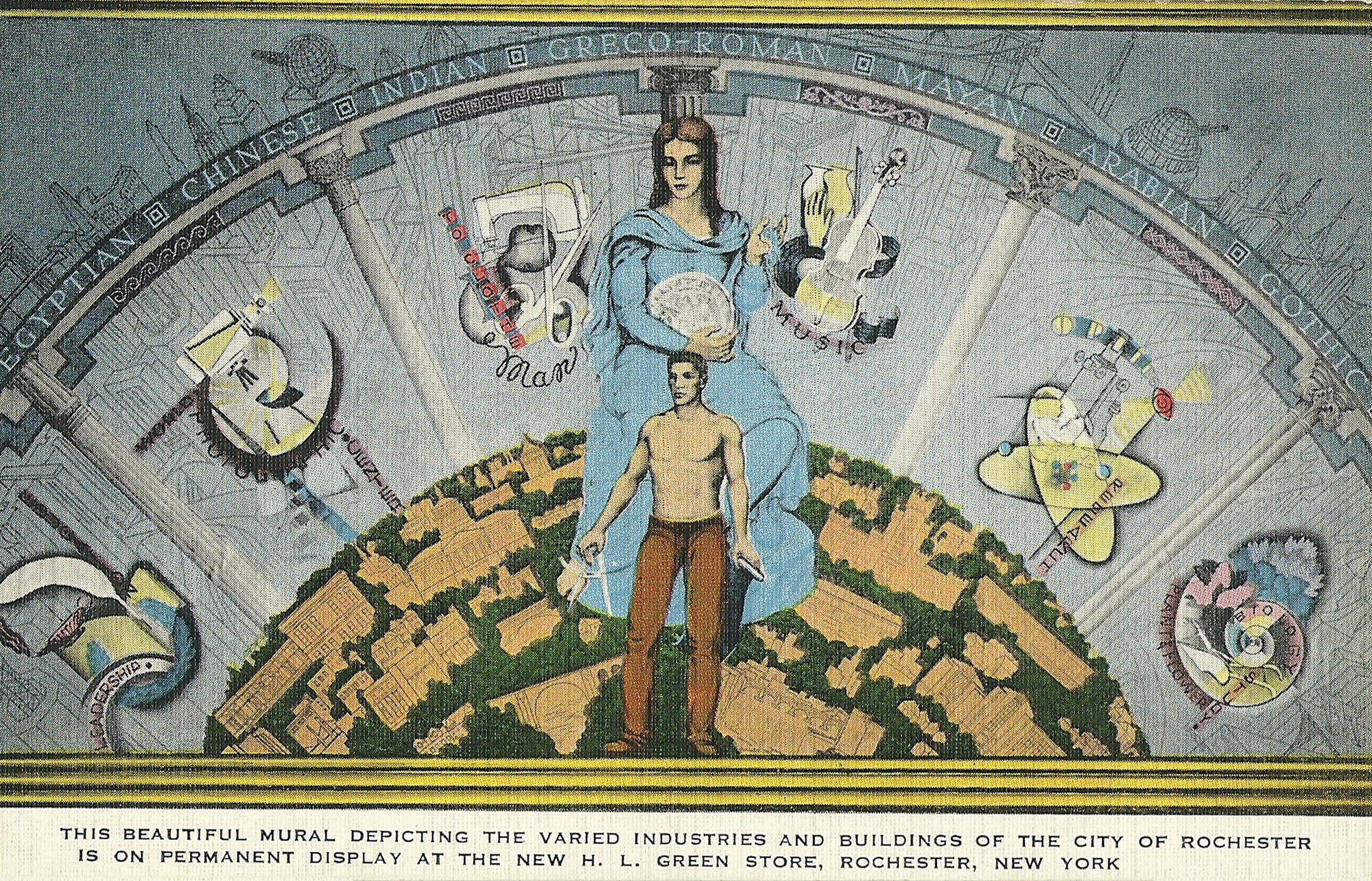
One particularly striking privately-funded work that has not survived into the present used to be installed on the wall of the H. L. Green Co. five-and-dime store at No. 134 Main Street East.

https://www.newspapers.com/article/democrat-and-chronicle-h-l-green-east/135365477/
After purchasing the Buell Estate Building at Nos. 132-34 East Main Street in 1942, the H. L. Green five-and-dime store commissioned a large and impressive work of art-deco style muralism.

https://www.newspapers.com/article/democrat-and-chronicle-all-rochester-is/135365364/
David Harriton was a well-known artist, whose Harriton Carved Glass Company created many works in carved glass. Harriton himself was known for his large carved glass murals, although it’s not clear whether this mural was glass or paint.
https://mcnygenealogy.com/pictures/4800/pic-4847.htm
A few landmark buildings can be made out in the mural: the Armory, the Rush Rhees Library, the Rundel Library, Kodak Tower, the Veterans Memorial Bridge, the High Falls.

https://www.newspapers.com/article/democrat-and-chronicle-mural-in-store/135365303/
When the mural was destroyed is anyone’s guess: the store doubtless went through numerous changes, including a major renovation in 1979, followed by a full renovation as the Atrium Building in 1988. The mural could have been removed during any of those events.

https://www.newspapers.com/article/democrat-and-chronicle-h-l-green-remod/135480528/

https://www.newspapers.com/article/democrat-and-chronicle-frederick-douglas/135485162/
Amusingly, plans for the Frederick Douglass Museum to develop in that space include a large mural as well, a portrait of Frederick Douglass himself standing five storeys tall.
Ephemural #2: Vesuvius on Jay
While the appeal of a mural expertly composed by a famous artist is obvious, the mural is a medium of expression available to anyone with access to a big wall. This was often the chosen canvas of children, and more than a few community mural projects use the opportunity to involve the creative energy of children and students in their murals.

https://www.newspapers.com/article/democrat-and-chronicle-mt-vesuvius-on-ja/135377004/
Though clearly the above wall painting wasn’t a huge landmark art piece, I’m nevertheless charmed by it.

Red: No. 348 Jay Street, address of the wall painted upon, belonging to Vincent Nebbia, a grocer.
Green: No. 346 Jay Street, home of mural painter Anthony Trapani.
https://www.loc.gov/resource/g3804rm.g3804rm_g06217195003/?sp=43&r=0.597,0.871,0.375,0.229,0
Part of the reason I like it is the sense of continuity–for the building this young man painted upon nearly seventy years ago bears a mural today, as well! As mentioned in a previous Gonechester, Orange & Grape, this area was the focus of The Fruit Belt Project, an identity-forming art and garden project of which talented Rochesterian artist Shawn Dunwoody played a leading role. As his site puts it:
The Fruit Belt Mural Project is a design based beautification movement to create a series of large-scale community driven public artworks, using creative thinking as a strategy to provide socially engaged art to transform a neighborhood that has been overtaken by blight and disinvestment.
https://www.dunwoode.design/

The 1970s: A Muralism Boom
The revivalist spirit of the bicentennial saw a sharp spike in muralism, with at least four new murals painted during the years 1976 to 1977 alone. The below article from 1980 points out several of these murals, particularly those along South Clinton.

https://www.newspapers.com/article/democrat-and-chronicle-your-guide-to/135441433/
Let us take a closer look at these lost murals mentioned above.
Ephemural #3: The YWCA Mural
A truly massive mural celebrating women was painted on the YWCA building at No. 175 North Clinton Avenue. The composition was designed by Rochesterian artist Claire Linskey and measured 2,400 square feet. The painting was done by local painter, Henry Krone:

https://www.newspapers.com/article/democrat-and-chronicle-ywca-mural/135445711/

https://www.newspapers.com/article/democrat-and-chronicle-ywca-mural-1/135441632/

https://www.newspapers.com/article/democrat-and-chronicle-ywca-mural-2/135441676/

https://www.newspapers.com/article/democrat-and-chronicle-ywca-mural/135441811/
The mural’s designer, Claire Linskey, passed away in 1996.
In the intervening years between 1996 and the present day, the wall was painted over, and now simply bears the YWCA initialism in white lettering:

Ephemural #4: Mortimer Street Garage
The same painter who worked on the YWCA mural also painted another mural, on an exterior wall of the Mortimer Street Garage, where it served as a backdrop for a popular but short-lived farmer’s market. The mural was of two birds within two trees, designed by former Rochesterian artist John F. Morrell. A quotation by Morrell’s daughter Ceil was inscribed: We are born to this world, make it our own. “Some bear fruit but never grow rich. Some grow rich but never bear fruit and die alone.”

https://www.newspapers.com/article/democrat-and-chronicle-john-francis-morr/135564798/
John F. Morrell passed away in 2010. Many of his creations live on, including a well-known Cleveland landmark, “Life is Sharing the Same Park Bench”:

A large iconic mural by John F. Morrell in Cleveland, Ohio
https://maps.app.goo.gl/j8vWBeuRFhbHKBo79
The mural was very large, as can be seen below:

https://www.newspapers.com/article/democrat-and-chronicle-mortimer-mural/135445532/
Henry Krone also worked on this painting, as well as the YWCA mural above.

https://www.newspapers.com/article/democrat-and-chronicle-farm-market-mural/135444111/
The mural can be seen over the heads of celebrants for the opening day of the farmer’s market in 1977:

https://www.newspapers.com/article/democrat-and-chronicle-farmers-market/135443681/
Financial Difficulties would force the Downtown Farmer’s Market to shutter its operations entirely. The lot returned to a simple parking lot, albeit with a fancy mural. Five years later, that too would change, as an expansion to the Mortimer Garage obscured the mural.

https://www.newspapers.com/article/democrat-and-chronicle-mortimer-garage-m/135443153/
It’s difficult to pin down exactly where the wall would have been which bore the mural; the Mortimer Street Garage addition in 1985 which obscured this mural was the section of garage on the corner of Mortimer Street and North Clinton Avenue. This means that the section of wall the mural was painted on was probably the older 1958 section of the Mortimer Street Ramp Garage, which was razed in early 2007. Presumably, it was the northern wall of the garage, which would have been adjacent to the old Paramount Theater until it was demolished in 1974. Therefore, the wall in question was most likely entirely pulverized.

A concept sketch of the 1958 Mortimer Street Ramp Garage, showing its position relative to the former Paramount Theater.
https://www.newspapers.com/article/democrat-and-chronicle-mortimer-ramp-gar/135565443/


Ephemural #5: The Good Will Wall
When beloved theater group GeVa first began, its home was within the old Rochester Business Institute building at No. 168 South Avenue, across from Washington Square Park. Artist Suzanne E. Brunner painted what she termed a “Good Will Mural” on the exterior wall of the building in 1977.
Unfortunately, photographs of this mural do not abound.

https://www.newspapers.com/article/democrat-and-chronicle-good-will-wall/135364006/
Judging by the position of the Xerox tower in the background of the above photo, this must have been a wall facing south; this being before Woodbury Boulevard was cut, this must mean that the view is north from [what was then] West Monroe Avenue, changed in 1978 to Woodbury Boulevard.

https://www.newspapers.com/article/democrat-and-chronicle-good-will-wall-2/135364080/
By 1986, GeVa had moved to its familiar present-day home in the former Naval Armory/Convention Hall at No. 75 Woodbury Boulevard. The wrecking ball followed shortly after for No. 168.

https://www.newspapers.com/article/democrat-and-chronicle-186-s-clinton-ru/135415569/
Shortly afterward it would become the site for 3 City Center:

Ephemural #6: Cinema Theater Mural
In 1977, numerous members of the Swillburg and Ellwanger-Barry neighborhoods worked alongside artist Monique Delettrez to create a mural on the wall of the Cinema Theater on the corner of South Goodman and South Clinton. This 113-foot mural depicted people from the neighborhood and people from Rochester’s history.

https://www.newspapers.com/article/democrat-and-chronicle-cinema-theatre-mu/135364810/
The mural would remain on display until August of 1984, when the owner of the building decided to sell off the property. The paint by this point was peeling, badly in need of a restoration. The neighborhood rallied around saving the mural.

https://www.newspapers.com/article/democrat-and-chronicle-hope-to-save-hist/135364716/

https://www.newspapers.com/article/democrat-and-chronicle-hoping-to-preserv/135364740/

https://www.newspapers.com/article/democrat-and-chronicle-mural-is-safe-if/135445013/
Offers were made to keep the mural if the neighborhood went through the efforts to restore it–within the two weeks before painters were set to cover it.
The mural was beiged on August 29th, 1984.

https://www.newspapers.com/article/democrat-and-chronicle-workmen-painted/135634884/

https://www.newspapers.com/article/democrat-and-chronicle-cinema-theatre-mu/134868476/
“The art of murals is a living art; It’s something you do to improve a situation. It’s not meant to be everlasting like a Michelangelo. It’s to get people to realize they are powerful. They can make something beautiful.”
Monique Delettrez

https://www.newspapers.com/article/democrat-and-chronicle-mural-2/135364606/

In the next Gonechester post we’ll examine some murals from the 1980s and afterwards which are no longer with us. That should be a real treat.
Supporting Gonechester
Did you enjoy what you read? Consider giving me a little tip at buymeacoffee.com/Gonechester, by way of saying “thanks!” It’s not necessary, but it certainly helps!


Leave a Reply