For my entire life, up until just a few years ago, I recall passing a very old and rather shambolic house at the corner of Goodman Street and the onramp to I-490 East. The strange placement, the layers of peeling paint, and the constantly-advancing decay of the house always made it stand out; it was clear to me that this was a house with a long history, around which many things had changed. That house, torn down in 2021, was No. 2 Eisenberg Place, and here I try to outline some of its story.

Looking north towards south face of No. 2 Eisenberg Place, 2020.
Above we see No. 2 Eisenberg Place as I most distinctly remember it from my drives down Goodman: painted both red and a thick layer of some sort of glossy pinky-purple, windows covered by mesh screens, an antique-looking railing propped against one wall, and a classic eagle motif to top it off.
The hole in the roof is on full display in the below photo:

Looking east towards west face of No. 2 Eisenberg Place, 2020.
Another, earlier image shows the antique railing more clearly. It rises along a very distinct grade from the road; that grade and the railing itself are remains of the approach to the iron bridge over the canal bed, and later on the subway.

Close-up of the old railing on the west side of No. 2 Eisenberg.
It coincides with the beginning of the southern approach to the bridge as noted on the Sanborn maps, and seems to agree with the angle of approach to a high canal bridge.

Red: Approach to the Goodman Street bridge over the canal.
https://www.loc.gov/resource/g3804rm.g3804rm_g06217195004/?sp=47&r=0.03,0.395,0.476,0.287,0
A book about the history of Southeast Rochester by Rose O’Keefe agrees with the assessment:

https://www.google.com/books/edition/Southeast_Rochester/Aoi_XrjzA4QC?hl=en&gbpv=0
(Also, I’m fairly certain that, contrary to the above caption, the Sherwood Shoe Factory buildings burned down on July 1st 1971, not the late 1950s, but that’s neither here nor there.)
Below, we have the photo that clinches it: a photo of the Goodman Street bridge over the subway. The railings on the approach to the bridge are the same as the one which remained at No. 2 Eisenberg.
Now I’m wondering what happened to that chunk of railing…

The Goodman Street bridge over the subway, looking north. No. 2 Eisenberg is to the right; the street sign says “Eisenberg Pl“.
https://www.libraryweb.org/~digitized/books/Subway_1925.pdf
The original Goodman Street bridge over the canal was wrecked in 1923 when the canal was converted into the subway; the replacement bridge was in turn wrecked in 1959 when the subway was replaced with the highway, and the modern steel-and-concrete bridge put into place.

The Goodman Street bridge over the subway, looking west.
https://www.libraryweb.org/~digitized/books/Subway_1925.pdf

Looking northwest towards east face of No. 2 Eisenberg Place, 2020.
The very first image-captures of No. 2 Eisenberg on Google Maps from 2007 show the property in somewhat more decent condition:

No. 2 Eisenberg Place as it appeared in 2007, looking northeast at southwest faces.
However, the property looks more like this now:

Looking northeast towards lot formerly holding No. 2 Eisenberg Place, 2024.
So where did this vanished house come from, and who called it home?
The Eisenbergs
The story of No. 2 Eisenberg Place begins, appropriately enough, with the Eisenberg family. Conrad Eisenberg was proprietor of a saloon and grocery on Pinnacle Avenue, corner of Meigs.
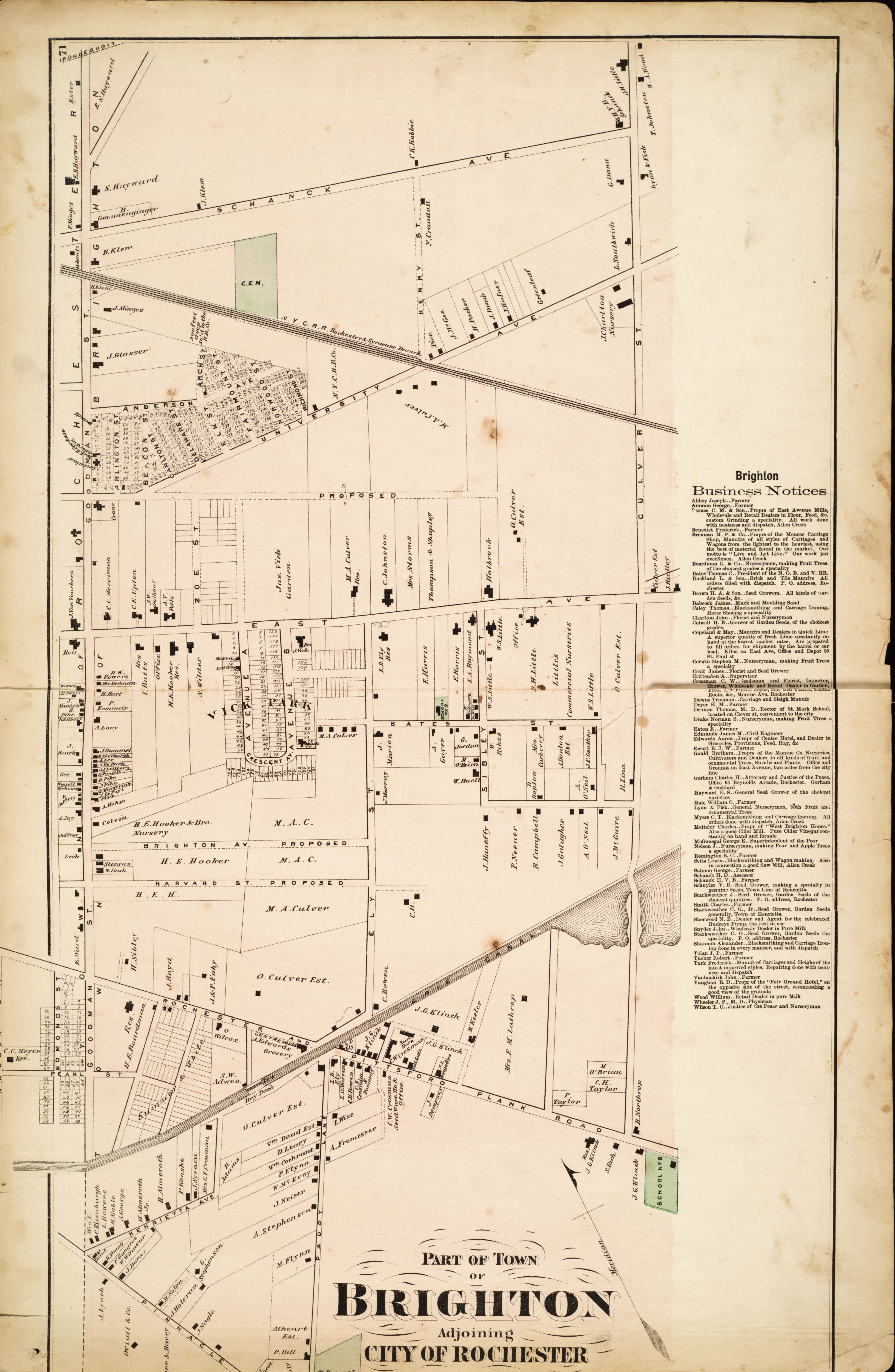
Worth noting is that Goodman Street did not yet–as of the beginning of the Eisenberg family’s occupation–bridge the Erie Canal, but ended instead on the north side of the canal.

Red: Two houses belonging to the Eisenbergs on Henrietta Ave. [Now Henrietta Street] “Mrs. E.” is Christine Eisenberg, Conrad’s Mother.
http://photo.libraryweb.org/rochimag/mcm/mcm00/mcm00022.jpg
Conrad’s father, Justus Eisenberg, was killed in the Civil War, during the second day of the Battle of Gettysburg–July 2, 1863. Conrad was himself a veteran of Gettysburg, but did not meet his father’s fate in battle.
Conrad’s widowed mother, Christina, lived in a house at No. 1 Henrietta Avenue [now Henrietta Street].

Red: Home of Christina Eisenberg
Orange: Home of K. Eisenberg
http://photo.libraryweb.org/rochimag/rpm/rpm00/rpm00161.jpg

Red: The Eisenberg houses on the corner of Henrietta Ave/St. and South Goodman Street.
https://www.loc.gov/resource/g3804r.pm006250/?r=0.738,0.519,0.148,0.083,0#

Corner South Goodman Street and Henrietta Street, former site of Christina Eisenberg’s home.

https://www.libraryweb.org/rochcitydir/images/1888/1888e-g.pdf

https://www.newspapers.com/article/democrat-and-chronicle-conrad-eisenberg/130561147/
On the below map, one can see the grocery store and home of Conrad Eisenberg at Nos. 206-208 Pinnacle Avenue, right at the corner of Meigs:

Red: Nos. 206-208 Pinnacle Avenue, grocery and saloon of Conrad Eisenberg.
https://photo.libraryweb.org/rochimag/rpm/rpm00/rpm00267.jpg

Red: No. 208 Pinnacle Avenue [S. Clinton] Conrad Eisenberg’s Grocery and Saloon.
Green: No. 206 Pinnacle Avenue [S. Clinton] home of Conrad Eisenberg and family.
https://www.loc.gov/resource/g3804rm.g3804rm_g06217189202/?sp=53&r=0.024,0.877,0.264,0.438,270
Pinnacle Avenue would be renamed South Clinton Street in 1893.

South Clinton and Meigs, former location of Conrad Eisenberg’s Grocery.
Conrad Eisenberg was married to Margareth Unamann, a member of a neighboring German family after whom another nearby street is named: Uniman Place. Her father was Adam Unamann, who brought Margareth to Rochester on a canal boat when she was 2 years old.


https://www.newspapers.com/article/democrat-and-chronicle-adam-unamann-obit/130561899/
Conrad Eisenberg would continue running the grocery and–apparently–a shoe store until his death in August of 1898, leaving his widow Margareth.

Businesses on north side of S. Clinton between Lester Pk. and Meigs St.
Yellow: Businesses owned by Conrad Eisenberg as of his year of death.
https://www.libraryweb.org/rochcitydir/images/1897/House_Directory_1897-1898.pdf

Pink: Christina Eisenberg, widow of Justus Eisenberg, mother of Conrad Eisenberg.
Yellow: Conrad Eisenberg, grocer.
https://www.libraryweb.org/rochcitydir/images/1898/1898e-ga.pdf

Pink: Christina Eisenberg, widow of Justus Eisenberg, mother of Conrad Eisenberg.
Yellow: Conrad Eisenberg, deceased.
Orange: The grocery store/saloon.
https://www.libraryweb.org/rochcitydir/images/1899/1899e-ga.pdf


https://www.newspapers.com/article/democrat-and-chronicle-obituary-for-conr/156179732/

The Eisenberg family grave plot in Mt. Hope Cemetery, with Margareth and Conrad Eisenberg’s markers at lower right.
https://www.findagrave.com/memorial/112032964/conrad-eisenberg
https://www.findagrave.com/memorial/112028700/margareth_eisenberg
Margareth Eisenberg would move in with her son William at No. 241 Linden Street, where she remained until her own death in 1932.

No. 241 Linden Street, home of William & Mary Eisenberg, Margareth Eisenberg.


https://www.newspapers.com/article/democrat-and-chronicle-obituary-for-marg/144728518/
As for the grocery store, that remained in the estate for many decades thereafter, being run by Conrad’s son William Eisenberg. It was first refit and operated as a restaurant, and then later became the Community Liquor Shop. Though the below excerpt from the Times-Union version of his obituary gives the business address as No. 814 Clinton Avenue North, it was–as we’ve covered already–No. 814 Clinton Avenue South:

July 19, 1938
https://www.libraryweb.org/~digitized/scrapbooks/biography_of_men/v_27.pdf
He was also president of the Erie Social Club, which held rooms in the second floor of the building.

https://www.newspapers.com/article/democrat-and-chronicle-william-eisenberg/156194546/
Eisenberg Park
Eisenberg Place was first opened to public traffic as Eisenberg Park, appearing in the directory in the year 1885 simply as “Eisenberg”, with “Park” appended in the 1886 directory. Conrad Eisenberg himself directed the construction of streets and dwellings in the tract:

https://www.google.com/books/edition/Proceedings/tbxEAQAAMAAJ?hl=en&gbpv=0

Red: No. 2 Eisenberg Park.
http://photo.libraryweb.org/rochimag/rpm/rpm00/rpm00266.jpg
In 1899, Eisenberg Park had its name changed; according to the newspaper, it was to become Eisenberg Street:

https://www.newspapers.com/article/democrat-and-chronicle-eisenberg-street/156227026/
However, the directory, maps, and physical real-life street ended up as Eisenberg Place. Why they changed it, I can’t say! People just liked it better that way.

https://www.libraryweb.org/rochcitydir/images/1899/1899contents,streets.pdf
Regarding No. 200 S. Goodman
Let’s take a quick moment to talk about Frederick Woldach. As one can see in the below map, there was a property labelled No. 200 South Goodman Street, between No. 2 Eisenberg and the Erie Canal. This was part of land owned by Frederick Woldach, a commercial florist, and purchased directly from Conrad Eisenberg in 1886.

Red: No. 200 South Goodman Street.
https://www.loc.gov/resource/g3804rm.g3804rm_g06217191204/?sp=82&r=0.406,0.677,0.291,0.484,90

https://www.newspapers.com/article/democrat-and-chronicle-conrad-eisenberg/156441023/

https://www.libraryweb.org/rochcitydir/images/1888/1888t-z.pdf
Frederick Woldach lived first in No. 3 Eisenberg Park and then No. 6½ Eisenberg Park until 1893, when No. 200 South Goodman Street was built, at which point that became his permanent address.

https://www.newspapers.com/article/democrat-and-chronicle-roses-for-easter/156442258/

https://www.libraryweb.org/rochcitydir/images/1911/House_Directory_1911-1912.pdf
The Scheys
In 1891, Charles Schey, a maltster, moved from No. 55 Benton Street to No. 2 Eisenberg Place.

https://www.libraryweb.org/rochcitydir/images/1891/1891re-sh.pdf

Red: No. 2 Eisenberg Place.
https://photo.libraryweb.org/rochimag/rpm/rpm00/rpm00191.jpg

https://www.newspapers.com/article/democrat-and-chronicle-charles-schey/101389397/
Charles’ widow Emma Wickford Schey, and her daughter Daisy, remained in the house until 1925, when it would pass briefly to a Mrs. Mildred F. Arnold, then the following year to Montford Thomas Pollock.

Red: No. 2 Eisenberg Place.
http://photo.libraryweb.org/rochimag/rpm/rpm00/rpm00308.jpg

Red: No. 2 Eisenberg Place
https://www.loc.gov/resource/g3804rm.g3804rm_g06217191204/?sp=82&r=0.406,0.677,0.291,0.484,90
The Pollocks
In 1926, Montford Thomas Pollock, a crane operator, and his wife Edna May Northrup Pollock moved one door west on Eisenberg Place, from No. 4 to No. 2 Eisenberg Place.

Red: No. 2 Eisenberg Place
Green: No. 4 Eisenberg Place
https://photo.libraryweb.org/rochimag/rpm/rpm00/rpm00110.jpg

https://www.libraryweb.org/rochcitydir/images/1926/1926p-q.pdf
Just two years later, in 1928, the Pollocks move to No. 2 Garfield Street, a no-longer-extant apartment building on the corner of Garfield Street and West Avenue which is now parking for Pooley Inc.

https://www.libraryweb.org/rochcitydir/images/1928/1928p-q.pdf

https://www.newspapers.com/article/democrat-and-chronicle-obituary-for-poll/156327028/
The Guyers
In 1929, Robert Andrew Guyer, a shoemaker, moved into No. 2 Eisenberg Place with his wife, Catherine M. Allmeroth Guyer; eldest son William J., also a shoemaker; and two other children, Esther and George.

https://www.libraryweb.org/rochcitydir/images/1929/1929g.pdf

Robert A. Guyer [standing] and his brother Daniel Guyer
https://www.ancestry.com/api/media/retrieval/v2/image/namespaces/1093/media/82a29c71-bfe0-44b7-9a61-94f13e39266d

https://www.newspapers.com/article/democrat-and-chronicle-3-awarded-damages/156341874/
If you heard a familiar note of Catherine Guyer’s maiden name, “Allmeroth”, then well observed! Catherine M. Allmeroth was a granddaughter of the Henrietta Street grocer Henry Allmeroth, whose family name was bestowed upon Allmeroth Street. The below sketch of Catherine’s uncle, George Allmeroth, goes into some detail:


https://libraryweb.org/~digitized/books/History_of_the_Brewery_and_Liquor_Industry_Rochester_NY.pdf
The Allmeroth grocery building on the corner of Henrietta Street and Allmeroth Street is still extant, most familiar to present-day Rochesterians as Rooney’s Restaurant.

Nos. 90-96 Henrietta Street, former location of the Allmeroth family grocery, saloon, and cafe.
The Jenkins
In 1933, John P. and Helena F. Steen Jenkins moved into No. 2 Eisenberg Place. I’m not sure what John Jenkins did; he is identified only by “lab” with no provided address at which he was labbing. I’ll assume he was actually, professionally, a labrador.

https://www.libraryweb.org/rochcitydir/images/1933/1933j-l.pdf
John and Helena had three children: John Jr., Jean, and Kathleen.
Most of the Jenkins’ contributions to the newspaper were in the form of classified ads, offering and asking sundry items for sale or trade. The items on offer give an intriguing material glimpse into the Jenkins’ life:

https://www.newspapers.com/article/democrat-and-chronicle-jean-jenkins-offe/156391924/

https://www.newspapers.com/article/democrat-and-chronicle-john-jenkins-ad/156323863/

https://www.newspapers.com/article/democrat-and-chronicle-folding-leather-s/156392038/

https://www.newspapers.com/article/democrat-and-chronicle-for-sale-heavy-g/156392118/

https://www.newspapers.com/article/democrat-and-chronicle-wont-some-one-pl/156392226/

https://www.newspapers.com/article/democrat-and-chronicle-puppy-wanted/156463816/
On so on, in that vein, selling off twin beds and folding chairs and raccoon collars and such.
Come 1938, the Jenkins moved from No. 2 Eisenberg to No. 401 Fernwood Avenue.

https://www.newspapers.com/article/democrat-and-chronicle-obituary-for-john/156397517/

The grave marker of John P. Jenkins.
https://www.findagrave.com/memorial/172817315/john-jenkins

https://www.newspapers.com/article/democrat-and-chronicle-obituary-for-hele/156397810/
The Babcocks
Boyd Babcock and his family moved into No. 2 Eisenberg Place in 1938. Boyd was a chauffeur.

https://www.libraryweb.org/rochcitydir/images/1938/1938a-b.pdf
Boyd’s wife, Bessie Ellen Campbell Babcock, was extremely fond of writing in her opinions to the Democrat and Chronicle, many of which concerned her favorite topic: dogs. The Babcock family was apparently quite fond of dogs, and had numerous dogs with which they also bred and sold puppies.

https://www.newspapers.com/article/democrat-and-chronicle-babcock-dachshund/124967617/


https://www.newspapers.com/article/democrat-and-chronicle-parent-sympathize/124967460/
The letter above reveals some interesting things, such as No. 2 Eisenberg and numerous other houses on the street being rentals, purportedly owned by the same landlord, who had two sisters.


https://www.newspapers.com/article/democrat-and-chronicle-on-dogs-and-kids/124967761/


https://www.newspapers.com/article/democrat-and-chronicle-queen-bess/124968061/
Though I was unable to verify Bessie Babcock’s claim to Nathanael Greene as an ancestor, one of her great-grandparents was named Zenas Greene, so it’s not wholly out of the question that there’s a relationship. Sussing out the veracity of her claim that her father had anything to do with the Duke of Argyll is an impossible task, but it seems to me in my lack of expertise that George Campbell was Duke around the time she mentions. I may be wrong, but she may be wrong too; who knows? Who even cares, beyond me?


https://www.newspapers.com/article/democrat-and-chronicle-very-pro-pooch/124969087/


https://www.newspapers.com/article/democrat-and-chronicle-leashing-like-com/124969201/

https://www.newspapers.com/article/democrat-and-chronicle-on-obscenity/124967318/
Besides Bessie’s many letters to the editor, the Babcocks mostly showed up in the papers for various petty transgressions, usually having to do with (poorly) operating or (possibly) stealing automobiles:

https://www.newspapers.com/article/democrat-and-chronicle-tipsy-driving/124968602/
The above, I’m guessing, was meant to be “Boyd” and not “Floyd”, which is somewhat amusing because two Floyd Babcocks did exist contemporaneously with this event, one who was also a chauffeur at No. 83 Poplar, and another who was a heating supply specialist living at No. 27 Thornton Road in Irondequoit.
Boyd and Bessie’s son Francis seemed to have a troubled youth. At sixteen, he was arrested and sent to the prison in Coxsackie for allegedly stealing a car.

https://www.newspapers.com/article/democrat-and-chronicle-denies-guilt/124971465/
He also had a violent streak, reportedly attacking the daughter of a mason after she turned down his advances:

https://www.newspapers.com/article/democrat-and-chronicle-vicious-parolee/124967046/
The victim of the assault, Jan Schweitzer, lived with her parents, Charles [who apparently went by “Jim”, oddly enough] and Clara Schweitzer, at No. 886 North Goodman Street, which was a frame house on the plot where Joy Community Church now stands. She would go on to marry a man named Charles Arbia and have a family.

https://www.newspapers.com/article/democrat-and-chronicle-collision/124967885/

https://www.newspapers.com/article/democrat-and-chronicle-suits/124968256/
Sometime between 1955 and 1959, Bessie and Boyd Babcock moved to Wolcott, NY, where they dwelt on Buchanan Road.

https://www.newspapers.com/article/democrat-and-chronicle-bessie-babcock-bu/124969640/
I was hoping to pinpoint where in Wolcott this was taken, but all I can find is that Edward’s Shoe Store was on Main Street. Sorry, I’ll do better next time.
Though no longer a denizen of Rochester, Bessie Babcock carried on her correspondences with the Democrat & Chronicle editor from her Wolcott perch:


https://www.newspapers.com/article/democrat-and-chronicle-flea-eating/124969481/

https://www.newspapers.com/article/democrat-and-chronicle-boyd-r-babcock-o/156231027/

https://www.newspapers.com/article/democrat-and-chronicle-obituary-for-bess/156234724/

Grave marker of Boyd and Bessie Babcock at Webster Rural Cemetery.
https://www.findagrave.com/memorial/136587280/boyd_raymond_babcock
https://www.findagrave.com/memorial/136587397/bessie_ellen_babcock
Since Then
So, that pretty much brings us up to the mid-1950s.

Red: No. 2 Eisenberg Place.
https://www.loc.gov/resource/g3804rm.g3804rm_g06217195004/?sp=47&r=-0.128,0.344,0.823,0.463,0
After that, records are sparse. There are no digitized directories after the 1940s, so data become more piecemeal. So, let’s fast-forward to today. I know I’m glossing over 65 or so years of history but, really now, do we need to get so in-depth?
Yes, that was a self-aware jibe at myself.
Anyhow, that covers the “early history” of No. 2 Eisenberg Street, and we’re already familiar with the “late history” of No. 2; getting covered in thick layers of paint while its roof collapsed, until it was razed in 2021. Now an empty, grassy lot awaits some future new development.

Looking east towards Eisenberg Place.
Supporting Gonechester
Did you enjoy what you read? Consider giving me a little tip at buymeacoffee.com/Gonechester, by way of saying “thanks!” It’s not necessary, but it certainly helps!




Leave a Reply