Last time we went into the history of one corner of East Main Street and Elm with the entry Before Midtown; let us now cross over Elm Street to another history-rich lot of land. Vaguely triangular in shape, this expensive lot of commercial real estate was once the site of Rochester’s most prominent homes.

No. 1 East Avenue.
https://maps.app.goo.gl/nZrna7jkjqz5BhZw7
For it was here, over 184 years ago, that Nehemiah Osburn built his homestead, and became a name inseparable from the history of Rochester.
Nehemiah Osburn
Nehemiah Osburn, twenty years old, lean and hungry from a life of work and want in assistance of his widowed mother, set out on foot from Scipio, New York towards the flourishing village of Rochester. It was 1821, and the young city was building up rapidly; Osburn was a dab hand at building, and made his talents available, which quickly gained him reputation and riches.

https://www.google.com/books/edition/History_of_Rochester_and_Monroe_County_N/ivssAAAAYAAJ?hl=en&gbpv=0

At this time, Osburn boarded with millwright Sylvanus Perry on Clinton Street.
https://www.libraryweb.org/rochcitydir/images/1827/1827boardersI-O.pdf
The given name Nehemiah echoes the name of Biblical figure Nehemiah, or נְחֶמְיָה, central figure of the Book of Nehemiah. He is supposed to have rebuilt the walls of Jerusalem despite fierce opposition from Israel’s enemies both without and within.

Etching of Nehemiah supervising the rebuilding of Jerusalem’s walls.
https://www.britannica.com/biography/Nehemiah
This name would turn out to be surprisingly apropos, for a man who built up the fabric of Rochester despite any setbacks, and became a central figure of our city’s early success.
The Osburn House
One of Osburn’s successful commercial ventures was the construction of the Osburn House, a 150-room hotel on the corner of Main and St. Paul Streets.
This was actually the second building Osburn constructed on the site; the first went up in 1845.

Wednesday, June 4, 1845

1847 Directory
The Osburn block, left, and the Blossom Hotel, right.
https://www.libraryweb.org/rochcitydir/images/1847/1847complete.pdf

Red: The Osburn House, corner East Main and St. Paul Street.
https://catalogplus.libraryweb.org/?section=resource&resourceid=1116704987
However, a massive fire on January 21st, 1854 began in the National Saloon in the basement of Osburn’s building. The fire spread rapidly, destroying both Osburn’s building and the Blossom Hotel next door.

Sunday, March 05, 1922
https://www.newspapers.com/article/democrat-and-chronicle-wamsley-brothers/177833795/
Osburn rebuilt almost immediately, constructing the Osburn House hotel.

April 11, 1883


https://www.google.com/books/edition/Rochester_s_Corn_Hill/UFpiRQsnc2cC?hl=en&gbpv=0
The top-hatted, Lincolnesque figure on the balcony in the photo above was supposedly Nehemiah Osburn himself.

https://www.libraryweb.org/rochcitydir/images/1863/1863complete.pdf

Red: The Osburn House.
https://catalogplus.libraryweb.org/?section=resource&resourceid=1116158604

The Original Osburn House, corner East Main and N. St. Paul Streets.
https://nyheritage.contentdm.oclc.org/digital/collection/p16694coll15/id/12801/

Red: The Osburn House.
https://www.loc.gov/resource/g3804r.pm006250/?r=0.479,0.32,0.111,0.067,0
In 1883, the hotel would close, and Osburn’s block would be remodeled to become a business block.

Red: The Osburn House Block, part of Sibley, Lindsay & Curr.
https://www.loc.gov/resource/g3804rm.g3804rm_g06217189201/?sp=5&r=0.144,0.789,0.633,0.356,0
Come 1893, Sibley, Lindsay & Curr were looking to expand into the block, and razed the building in favor of constructing its current occupant, the tall Granite Building:

Wednesday, January 25, 1893
https://www.newspapers.com/article/democrat-and-chronicle-granite-building/131364126/
Demolition of the old Osburn House Block began Saturday, March 25th, 1893:

Saturday, March 25, 1893
https://www.newspapers.com/article/democrat-and-chronicle-the-new-granite-b/186519399/

Northeast corner North St. Paul and East Main Streets; the Granite Building.
Former site of first Osburn House hotel.
https://www.democratandchronicle.com/story/news/local/rocroots/places/2016/10/13/rocroots-granite-building/92005376/

The Granite Building, former site of original Osburn House.
https://maps.app.goo.gl/rKsmzZg4ikRNi9Ey6
New Osburn House
In 1882, Osburn built a new Osburn House hotel on South St. Paul Street across from the aqueduct, using the proceeds from the sale of his previous block:

Friday, February 4, 1882

Wednesday, May 10, 1882
https://www.newspapers.com/article/democrat-and-chronicle-gilt-sign-for-new/186514757/

Tuesday, May 16, 1882
https://www.newspapers.com/article/democrat-and-chronicle-the-new-osburn/186514944/

Green: New Osburn House.
https://catalogplus.libraryweb.org/?section=resource&resourceid=1116714363

“New Osburn House” sign on canal wall. The Osburn House stands above left.
https://catalogplus.libraryweb.org/?section=resource&resourceid=1430487897

The New Osburn House.
https://catalogplus.libraryweb.org/?section=resource&resourceid=1116691330

The New Osburn House.
https://catalogplus.libraryweb.org/?section=resource&resourceid=1116901400

The Milner Hotel, formerly the New Osburn House.
https://catalogplus.libraryweb.org/?section=resource&resourceid=1116152865

Sunday, April 26, 1959
https://www.newspapers.com/article/democrat-and-chronicle-wil-be-razed/186522525/
The old hotel was torn down in May of 1959, and Broad Street was run through a large portion of the former site.

South Avenue and Broad Street, present-day location of former New Osburn House.
https://maps.app.goo.gl/yhFYPHMvyFbbYv5j7
Osburn’s Homestead
Nehemiah Osburn’s home was a stately mansion house constructed around 1841-1842 on the corner of East Main and Elm Streets. It was surrounded by a white wooden fence with paneled gateposts topped with carved wooden flower vases. A large, stately elm tree stood in the yard, which was nearly struck by the falling Liberty Pole during a windstorm in 1889.

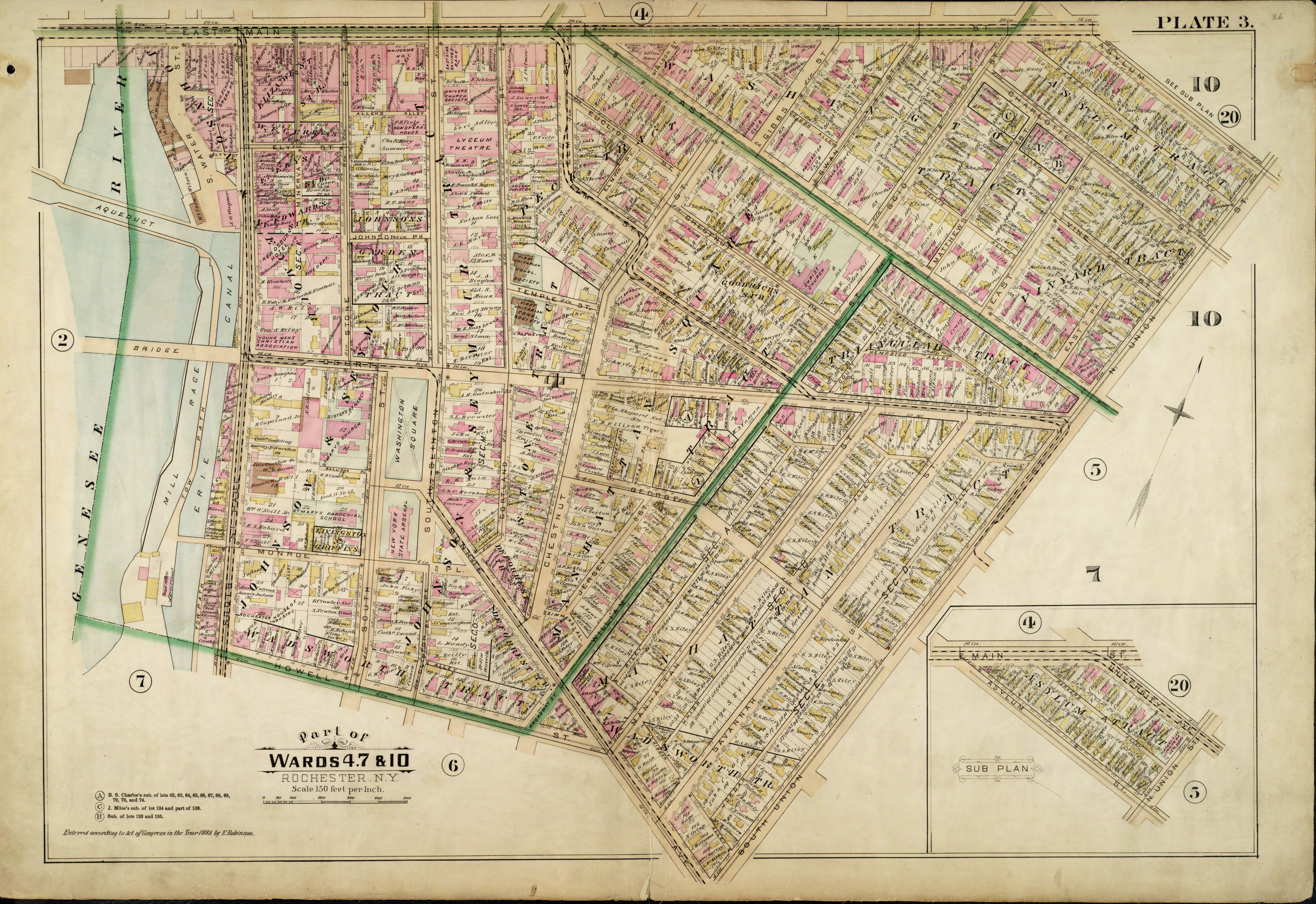
Red: Home of Nehemiah Osborn.
https://catalogplus.libraryweb.org/?section=resource&resourceid=1116704987

Red: Nehemiah Osburn’s mansion, corner Main and Elm Streets, East Avenue.
https://rochesterhistory.rit.edu/artifact/rochester-map/

Red: No. 1 East Avenue, home of Nehemiah Osburn.
https://catalogplus.libraryweb.org/?section=resource&resourceid=1116158670
1966’s “East Avenue’s Turbulent History” describes Nehemiah’s house as “Greek Revival”, but the cupola strikes me as a bit on the Italianate side. Someone with a keener eye for architecture may correct me on this point.

No. 1 East Avenue, home of Nehemiah Osburn.
https://catalogplus.libraryweb.org/?section=resource&resourceid=1115940822
The above, upon inspection, is mirrored. It should appear as below:

https://libraryweb.org/~rochhist/v28_1966/v28i2-3.pdf
The house just beyond Osburn’s to the east, No. 3 East Avenue, was the home of his daughter, Mary Elizabeth Osburn, until it was sold to tailor Augustus G. McNerney in 1887. He built a storefront onto the small mansion and operated his tailor shop out of the resulting building.
Osburn’s mansion was notable for its surrounding fence, with the paneled fenceposts topped with carved vases full of flowers. These are noted in an article:

Sunday, February 25, 1923
https://www.newspapers.com/article/democrat-and-chronicle-fence-gate-posts/186412629/
The house on the corner of Fitzhugh and Troup referred to by “John” in the above article as having a similar fence to the Osburn house was No. 110 South Fitzhugh Street, the house often referred to as “The Chapin House”; this was torn down in 1957 in favor of the Civic Center.
According to Jenny Marsh Parker in Rochester: A Story Historical, these fenceposts were the work of an artist named Peter La Place, who was also responsible for a wooden ox that decorated the Front Street public market when it was extant.


https://www.google.com/books/edition/Rochester/3qE3AQAAMAAJ
This is, however, the only mention I was able to find of Peter La Place, anywhere, except other articles using Parker’s book as a source.
Below, from the Centennial History of Rochester, is an architectural illustration of the doorway to Nehemiah Osburn’s house, as measured and drawn by Claude F. Bragdon.

Volume II: Home Builders
Illustration of doorway to Nehemiah Osburn’s house.

Red: Home of Nehemiah Osburn, No. 1 East Avenue.
https://photo.libraryweb.org/rochimag/rpm/rpm00/rpm00244.jpg

View from East Avenue towards East Main Street; the northwestern end of Osburn’s fenced yard can be seen at left.
https://nyheritage.contentdm.oclc.org/digital/collection/p16694coll15/id/12744/

https://www.libraryweb.org/rochcitydir/images/1892/House_Directory_1892.pdf

Red: No. 1 East Avenue, the home of Nehemiah Osburn.
https://www.loc.gov/resource/g3804rm.g3804rm_g06217189202/?sp=11&r=0.239,-0.017,0.708,0.398,0
The second day of 1892, Sarah Ann Van Schuyver, Osburn’s wife, died from a sudden onset of influenza.

Saturday, January 02, 1892
https://www.newspapers.com/article/democrat-and-chronicle-sarah-a-osburn-o/171950564/
The loss of his wife so shocked Nehemiah that his own health became moribund; he would die only nine days after his wife, on the 11th of January, 1892.


Monday, January 11, 1892
https://www.newspapers.com/article/democrat-and-chronicle-nehemiah-osburn-o/131858493/

The Osburn family grave plot; Nehemiah Osburn’s marker is “FATHER”, broken, with stone.
Sarah Anne Schuyver’s marker is “MOTHER”.
https://www.findagrave.com/memorial/7604810/nehemiah-osburn
https://www.findagrave.com/memorial/7604814/sarah_ann-osburn
Security Trust
After the death of Nehemiah Osburn, the Security Trust Company purchased the Osburn homestead and refitted it to be a bank. Plans were initially made to erect a building on the site.

Thursday, December 22, 1892
https://www.newspapers.com/article/democrat-and-chronicle-osburn-house-site/171950732/
This plan did not come to fruition; the Security Trust Company instead moved into quarters in the Granite Building.

Sunday, February 04, 1894
https://www.newspapers.com/article/democrat-and-chronicle-security-trust-wi/171953367/
The gas and electric lighting fixture shop of Charles K. Summerhays rented the old Osburn home.

https://www.libraryweb.org/rochcitydir/images/1894/1894complete.pdf
Osburn’s Homestead Razed
The Nehemiah Osburn homestead was marked for demolition in 1895. The Liberty Building Company was given a contract to build a two-story brick building with stone trimmings. Fitted to the trianguloid lot, the building would be dubbed “The Liberty Building”.

Tuesday, July 02, 1895
https://www.newspapers.com/article/democrat-and-chronicle-new-commercial-bu/171954773/
The First Methodist Tablets
During the demolition of Nehemiah Osburn’s mansion at East Main and Elm Streets and East Avenue, two stone tablets were discovered covering a disused well on the Elm Street side of the property:


The tablets of stone had once been set into the walls of First Methodist Church, northwest corner of Buffalo [West Main] and Fitzhugh Streets. The stone church was constructed in 1831 as a replacement for the former wooden church. A scant few years later, on January 5th, 1835 it was ruined by fire, and rebuilt with considerable charitable support.

Red: First Methodist Church, corner Buffalo and Fitzhugh Streets.
https://catalogplus.libraryweb.org/?section=resource&resourceid=1116704987

The First Methodist Church, rebuilt after the fire. Corner of Buffalo and Fitzhugh Streets.
https://libraryweb.org/~digitized/books/Sketches_of_Rochester.pdf
The above engraving from O’Reilley’s Sketches of Rochester is noteworthy, because the interior was still under construction as of the time of publication in 1838.
Returning to the original tablet article:


According to the above, Nehemiah Osburn’s house was built 1842. In 1854, the First Methodist Episcopal Church abandoned the church on the corner of Fitzhugh and Buffalo Streets; the congregation moved into another lot on Fitzhugh Street, where it remained until the church’s destruction by fire in 1933. As he was engaged in the demolition work, Osburn kept the tablets from the abandoned church, and kept them for a little over forty years.
The corner of Fitzhugh and Buffalo would become the site of the Baker’s Block, and then the Duffy, McInnerney & Co. building.
Finishing out the article:

Sunday, July 07, 1895
https://www.newspapers.com/article/democrat-and-chronicle-stone-tablets-at/170378986/
The above article finishes off with the story about Peter La Place’s part in carving both Osburn’s fence and the Front Street public market ox, but again this seems to be in reference to Jenny Marsh Parker’s history.
It is interesting that there is a certain class of historical artifact which is only ever uncovered in the event of destroying another historical artifact. A sort of karmic trade-off of historicity. In some ways, it takes the keen edge of bitterness off the loss of yet another bit of our shared, storied past.
The Liberty Building
As soon as the Osburn homestead was torn down, construction on the Liberty Building began. A two-story block with street-facing shops on the bottom level, this represented some of the most valuable commercial real estate in the city. A new building had just been built across Elm Street the previous year, and the old Triangle Building across East Avenue was to come down in 1896 in favor of a new, larger Triangle Building. The whole of the Seven Corners was undergoing rapid changes, and business was booming.
Designed by famed architect J. Foster Warner, the completed Liberty Building was noteworthy for a few particular features: a five-foot balustrade along the roof punctuated with eight flagstaffs; a sculpture of an eagle over the main entrance; and signage of gold letters on a green ground.


Thursday, September 19, 1895
https://www.newspapers.com/article/democrat-and-chronicle-the-new-liberty-b/171937236/
The above diagram shows the location of various shops within the Liberty Building’s first floor.
The Salter Bros., on East Avenue, was a florist owned by Albion H. and Richard G. Salter.


Thursday, November 07, 1895
https://www.newspapers.com/article/democrat-and-chronicle-salter-bros-open/186455660/
Just around the corner, on Main Street, the grocery store of John A. Seel.

Thursday, November 07, 1895
https://www.newspapers.com/article/democrat-and-chronicle-j-a-seel/186476090/

Advertisement for John A. Seel, Grocer.
https://archive.org/details/cu31924030288843/page/n89/mode/2up
Seel’s East Main neighbor on the corner of Elm was the bicycle shop of Robert Thomson.

https://www.libraryweb.org/rochcitydir/images/1896/1896complete.pdf
Robert Thomson’s shop had a special entrance for bicycles off of Elm Street, and a riding academy on the second floor.

Saturday, November 09, 1895
https://www.newspapers.com/article/democrat-and-chronicle-a-card-to/186503370/

Monday, November 11, 1895
https://www.newspapers.com/article/democrat-and-chronicle-thomsons-bicycle/186486184/
Next to the Salter Bros. on the East Avenue side, C. W. Trotter & Son sold stoves and ovens.

Thursday, December 12, 1895
https://www.newspapers.com/article/democrat-and-chronicle-c-w-trotter-s/186484552/
Beside the Trotters, Thomas W. Ford conducted his plumbing business.

https://www.libraryweb.org/rochcitydir/images/1898/1898complete.pdf
And, last on East Avenue, George W. Ross-Lewin, wallpaper and window-shades. Ross-Lewin was the first retail outlet to occupy the Liberty Building, before it was entirely completed. He put out numerous ads detailing the progress of the new building.

Tuesday, October 01, 1895
https://www.newspapers.com/article/democrat-and-chronicle-george-w-ross-le/186487516/
And of course, the whole of the second floor was held by C. K. Summerhays Co., proprietor Charles Kenwood Summerhays, selling gas and electric lighting fixtures.

https://www.libraryweb.org/rochcitydir/images/1896/1896complete.pdf
Watercolor artist G. Hamner Croughton also maintained a studio in the Liberty Building.

Saturday, February 01, 1896
https://www.newspapers.com/article/democrat-and-chronicle-g-hamner-crought/186503977/

Red: The Liberty Building, former site of Nehemiah Osburn mansion.
https://catalogplus.libraryweb.org/?section=resource&resourceid=1116153406

East Avenue looking south from East Main Street.
The building at right is the Liberty Building.
https://catalogplus.libraryweb.org/?section=resource&resourceid=1116137811
The above postcard shows the East Main Street end of the Liberty Building, where two stores, Nos. 293 and 295 East Main Street. Only No. 295 is visible, the former J. A. Seel grocery, and the business in it as of this time was the Hoffman House Coffee Co. This short-lived coffee shop was only at this location between 1905 and March of 1907, when they moved to the Palmer Block at No. 277 East Main Street. Thereafter, this storefront became Seneca Amusement Co.

Wednesday, March 13, 1907
https://www.newspapers.com/article/democrat-and-chronicle-hoffman-house-cof/186454674/

Elm Street looking northwest towards East Main Street.
Red: The Liberty Building.
https://catalogplus.libraryweb.org/?section=resource&resourceid=1115970114

The Liberty Building.
https://catalogplus.libraryweb.org/?section=resource&resourceid=1116718002

The Liberty Building is at far right.
https://catalogplus.libraryweb.org/?section=resource&resourceid=1116109345

East Avenue looking south from East Main Street.
The building at right is the Liberty Building.
https://nyheritage.contentdm.oclc.org/digital/collection/p16694coll15/id/19206/rec/164
The shops along the east side of the Liberty Building, on the west side of East Avenue, during the 1920s is visible above. The presence of a traffic tower in the image relegates this to a period of four years, 1924-1927, which seems to line up with the businesses listed in the house directory.
The archway door trimmed out in white, with flags over the door, was a retail location of Whittle’s, a chocolatier and confectioner, proprietor Thomas A. Whittle.

Whittle’s Candy advertisement.
https://mcnygenealogy.com/book/lyceum-1918-april.pdf
Just beyond that is the luggage and leather goods store of George A. Miller.

George A. Miller luggage advertisement.
https://mcnygenealogy.com/book/lyceum-1918-april.pdf

Green: The Liberty Building.
https://catalogplus.libraryweb.org/?section=resource&resourceid=1116136455
The Hippodrome
Beyond mere shops and offices, however, was one magnificent theatre that dwelt within the Liberty Building: The Hippodrome.

Wednesday, April 22, 1908
https://www.newspapers.com/article/democrat-and-chronicle-hippodrome-improv/186474240/

Sunday, April 26, 1908
https://www.newspapers.com/article/democrat-and-chronicle-the-hippodrome/186470957/

Entrance to the Hippodrome, East Main Street. McCurdy’s is at far right.
Note also, the dentist office of Dr. Oakley Woodin Norton, second window, above.
https://collections.eastman.org/objects/85333/group-of-people-in-front-of-the-hippodrome-theater-rochest
This theatre featured both “moving pictures” and a number of small-stage, Vaudeville-style acts.

Sunday, July 17, 1949
https://www.newspapers.com/article/democrat-and-chronicle-l-grace-drew/186475039/

Red: The Hippodrome Theatre.
https://www.loc.gov/resource/g3804rm.g3804rm_g06217191205/?sp=4&r=0.379,0.053,0.473,0.266,0

Friday, February 21, 1908
https://www.newspapers.com/article/democrat-and-chronicle-hippodrome/186472151/
The spectacular theatre was destroyed in 1925.
Grant-Liberty Building
In 1925, the Liberty Building was leased by the W. T. Grant Company, a mass merchandiser; the company drew up plans to have the Liberty Block torn down and replaced with a larger, more modern two-story building. This would be known as the Grant-Liberty Building.

Saturday, February 07, 1925
https://www.newspapers.com/article/democrat-and-chronicle-w-t-grant-compa/171952130/
The Grant-Liberty Building was completed too late in 1926 to make its way onto the 1926 plat map, but it is on the 1935 plat map:

Red: The Grant-Liberty Building.
https://catalogplus.libraryweb.org/?section=resource&resourceid=1116707477

Red: The Grant-Liberty Building.
https://www.loc.gov/resource/g3804rm.g3804rm_g06217195001S/?sp=16&st=image&r=0.203,0.042,0.641,0.36,0

The W. T. Grant Co. at No. 293 East Main in the 1950s.
https://www.democratandchronicle.com/story/money/business/2022/03/14/wt-grant-co-had-huge-presence-rochester-ny-what-happened/9452929002/

Tuesday, February 21, 1961
https://www.newspapers.com/article/democrat-and-chronicle-building-at-east/186197590/

Thursday, February 01, 1962
https://www.newspapers.com/article/democrat-and-chronicle-grant-downtown-st/172071019/
Security Trust Building


Thursday, January 11, 1962
https://www.newspapers.com/article/democrat-and-chronicle-security-trust-to/186637311/

Wednesday, May 02, 1962
https://www.newspapers.com/article/democrat-and-chronicle-razing-of-liberty/186637571/
With barely a moment after the Grant-Liberty razing to allow the lot to catch its breath, construction began anew on the fourth building to stand at East Main, East Ave, and Elm over the past century. A tall, boxy tower standing atop thin pillars, the new Security Trust building was to be a defiant change from the sedate traditionalism exhibited on the corner previously. Far from yesterday’s classic Greek Revival manse or balustrade-topped brick block, this monolith of commercial activity stood tall and gleamed with white panels vertically stroked with black smoked-glass windows.

Sunday, March 17, 1963
https://www.newspapers.com/article/democrat-and-chronicle-security-trust-mo/172071279/

https://www.democratandchronicle.com/picture-gallery/news/local/2023/11/27/gallina-development-corp-is-looking-for-tenant-for-one-east-avenue/71669531007/

Saturday, June 01, 1963
https://www.newspapers.com/article/democrat-and-chronicle-topping-off/186638089/

Thursday, December 12, 1963
https://www.newspapers.com/article/democrat-and-chronicle-security-trust-bu/172071510/

https://www.democratandchronicle.com/picture-gallery/news/local/2023/11/27/gallina-development-corp-is-looking-for-tenant-for-one-east-avenue/71669531007/

Sunday, October 25, 1964
https://www.newspapers.com/article/democrat-and-chronicle-final-girders-go/172071646/

Sunday, October 25, 1964
https://www.newspapers.com/article/democrat-and-chronicle-new-downtown-land/186639267/

Tuesday, November 17, 1964
https://www.newspapers.com/article/democrat-and-chronicle-plaza-opens/186639476/

Sunday, February 04, 1968
https://www.newspapers.com/article/democrat-and-chronicle-security-trust-bu/172070214/
A little over six decades since its construction, perhaps the novelty has worn off. But it’s certainly a familiar face along East Main Street. Would the old Liberty Building have drawn the eye so strongly? Perhaps. Most certainly, those few fanatics of history would be pleased to look at this corner and see Nehemiah Osburn’s 185-year-old Greek Revival mansion still standing guard. But One East Avenue stands out like few other buildings do.

No. 1 East Avenue as it appears at present, left.
https://maps.app.goo.gl/3AHBHjSDMN9B47iWA
And so, next time you pass this oddly-shaped lot at the confluence of many roads, think a bit on the long history that is buried beneath the tenterhooks on which the present building stands. Give a nod to old Nehemiah Osburn, and remember the many men and women who made their living here. Their moments did not go by unheeded.
A Plea for Support
I know a lot of things demand your money around this time of year, but for Gonechester, January is when the server fees come due. If you’ve enjoyed reading Gonechester over the course of 2025, and would like to see it keep going throughout 2026, consider stopping by my tip jar at buymeacoffee.com/Gonechester and dropping something in it. Thank you, and happy holidays!


Leave a Reply